About
I'm Marc — a scientist by day and an astrophotographer by night. I lead a research lab in biotechnology, where I spend my days optimising fermentation processes, engineering enzymes and automating laboratory workflows. I’ve been fascinated by the wonders of our night sky since I first looked through the telescope at our school's observatory (lucky me!).
As clear nights in Switzerland are few and far between, I now operate a remote imaging setup in Spain, where dark skies and clear conditions let me capture deep-sky objects from hundreds to millions of light-years away — galaxies, nebulae, and star clusters that are invisible to the naked eye. The telescope runs autonomously through the night while I'm at home sleeping.
What draws me to astrophotography is that it sits at the intersection of science and art. Every image starts as hundreds of individual exposures — often 20+ hours of total integration time — that get calibrated, stacked, and carefully processed to reveal structures hidden in the noise. It's methodical, technical, and deeply rewarding.
Beyond the deep sky, I photograph the places I travel — you'll find those images under Places.

Observatory and Equipment
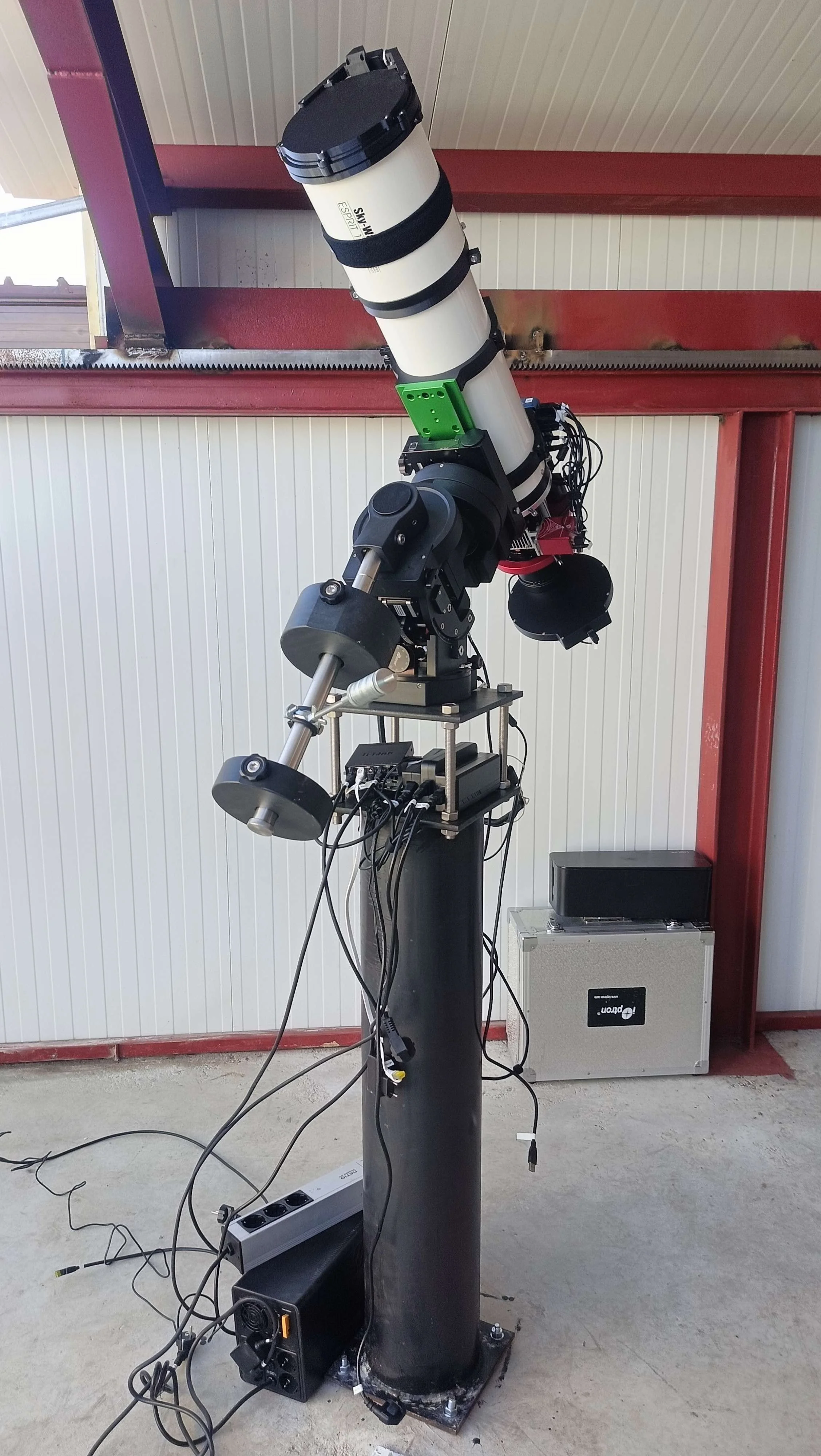
My imaging rig is located at a remote hosting site near A Veiga, Spain, at an elevation of 1254 m, under Bortle 2 skies. The telescope is housed in a shared building with a roll-off roof and operated remotely via NINA.
An Intel NUC on site handles acquisition, autoguiding, and equipment control. Raw frames are transferred to my home network for processing.
Telescope: Sky-Watcher Esprit 120ED (native: 840mm, F7 / 0.77x reduced: 647mm, F5.6)
Mount: iOptron CEM70G
Camera: ZWO ASI2600MM Pro
Filters: Antlia 2” 2.5nm SHO Ultra + LRGB Dark
Filter wheel: ZWO EFW 7x2”
Rotator: WandererAstro Potator Pro M92
Guide camera: ZWO ASI174MM + OAG
Focuser: ZWO EAF
Flat panel: DeepSkyDad FP2
Power management: PegasusAstro Pocket PowerBox Advance Gen2 + USB Control Hub
Acquisition and Processing
Imaging sessions are planned around target altitude, moon phase, and weather. A typical session runs autonomously overnight, capturing 240s sub-exposures through narrowband filters (Hα, OIII, SII) or 120s sub-exposures through broadband LRGB, depending on the target.
Autoguiding runs through PHD2, and the sequence is managed by the Target Scheduler plugin in NINA, which includes automated target selection, meridian flips, dithering, and autofocus routines.
Most of my deep-sky images use the Hubble palette (SHO). Some targets — particularly galaxies — are imaged in natural-colour LRGB.
Once raw data arrives at my home workstation, it goes through a multi-stage pipeline.
Hardware: AMD Ryzen 9 7950X3D, 64 GB RAM, Nvidia GeForce RTX 4090, NVMe storage, Synology NAS
Stacking: Calibration, registration, and integration in PixInsight using weighted batch preprocessing
Post-processing in PixInsight: (order depends on target)
Dynamic background extraction to remove gradients
Deconvolution (BlurXTerminator)
Noise reduction (NoiseXTerminator)
Star removal (StarXTerminator) for separate processing of stars and nebulosity
MultiScaleAdaptive stretch and curves
Channel combination and SHO palette mapping
Colour calibration and saturation adjustments
HDR multiscale transform for detail in bright cores
Final touches in Affinity Photo: Fine colour adjustments, selective sharpening, and export.
A single image typically takes 2-4 hours of hands-on processing time. Complex mosaics or faint targets can take significantly longer.